
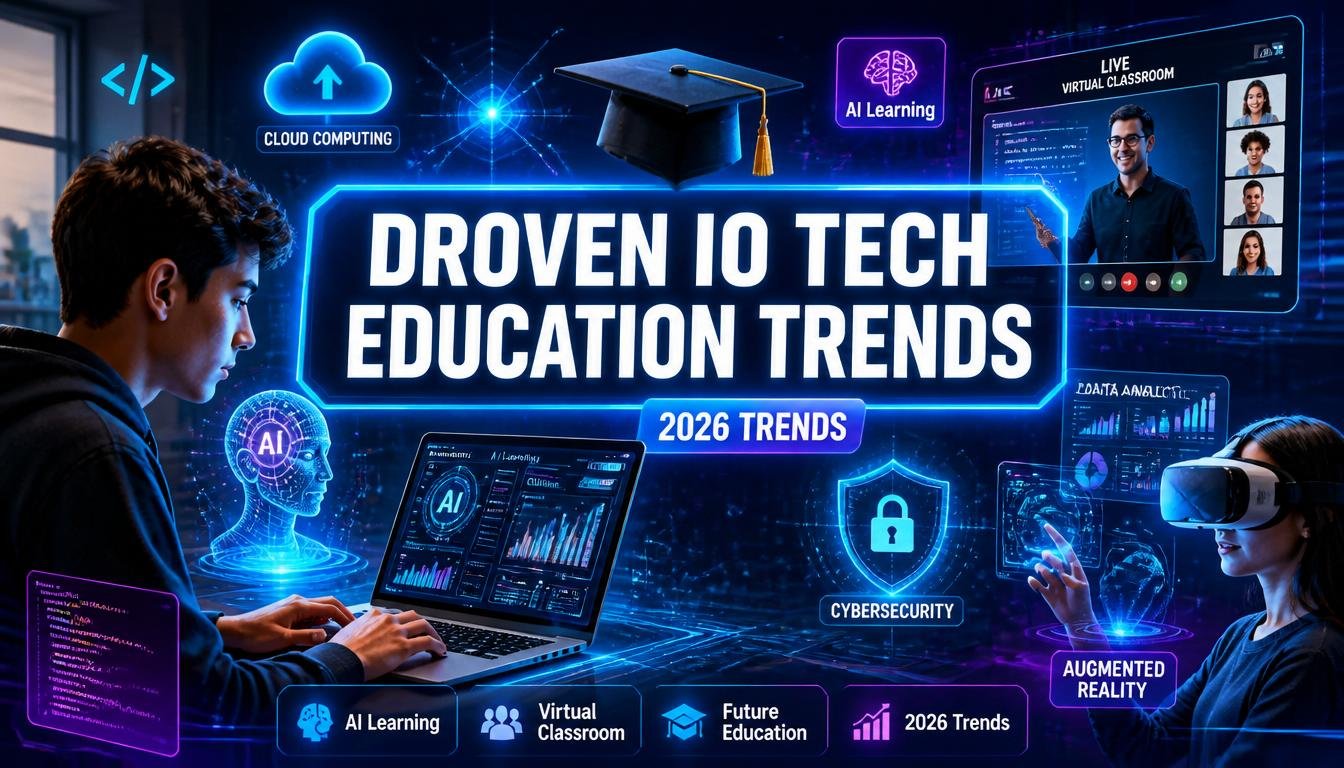
Droven io Tech Education Trends: Complete Guide to the Future of Learning in 2026
Technology is changing education faster than ever before. A few years ago, many students learned only inside a classroom with books and notebooks. Today, learning can happen almost anywhere. A student can join an online class from home, watch a science video on a phone, or use an AI tool to understand a difficult lesson. This new way of learning is helping people of all ages study in smarter and easier ways.
That is why many people are searching for droven io tech education trends. They want to know how technology is changing schools, colleges, online courses, and workplace training. Parents want better learning for their children, teachers want useful digital tools, and students want skills that will help them in the future.
In this guide, you will learn about the biggest education technology trends of 2026. We will explain each topic in simple English with real-life examples, expert insights, and practical tips. By the end of this article, you will understand why technology is becoming one of the most important parts of modern education.
Featured Snippet
Droven io tech education trends describe the latest technology changes in education. These trends include artificial intelligence, personalized learning, online classrooms, cloud learning, virtual reality, digital skills, and smart teaching tools that help students learn faster, teachers teach better, and schools prepare learners for future careers.
Table of Contents
- What Are Droven io Tech Education Trends?
- Why Educational Technology Is Growing So Fast
- Artificial Intelligence Is Making Learning Smarter
- Personalized Learning Helps Every Student
- Online and Hybrid Classrooms Continue to Grow
- Cloud Technology Is Improving Education
- Gamification Makes Learning More Fun
- Virtual Reality and Augmented Reality in Education
- Data Analytics Helps Students Succeed
- Digital Skills Are More Important Than Ever
- Challenges of Modern Educational Technology
- The Future of Learning in 2026 and Beyond
- Conclusion
- FAQs
What Are Droven io Tech Education Trends?
Education has changed a lot over the last few years. Today, students are not limited to learning from printed books or classroom lectures. They can watch educational videos, join live online classes, complete quizzes on mobile apps, and even ask AI tools for help. These changes are part of what people call droven io tech education trends.
The phrase does not describe one single platform or product. Instead, it refers to the latest ideas and technologies that are improving education. These include artificial intelligence, digital classrooms, cloud-based learning systems, virtual reality, educational apps, smart teaching tools, and many other innovations. Together, these technologies help make learning easier, faster, and more flexible for everyone.
One of the biggest reasons these trends are becoming popular is that learning is no longer limited by time or place. A student living in a small town can attend lessons from a teacher in another country. A working professional can learn new skills after office hours without leaving home. This flexibility gives people more opportunities to continue learning throughout their lives.
An education technology expert would explain that technology works best when it supports teachers instead of replacing them. Good teachers provide guidance, answer questions, and motivate students, while technology helps deliver lessons in smarter ways. When both work together, students often achieve better learning results and build stronger problem-solving skills.
Why Educational Technology Is Growing So Fast
The world is changing quickly, and education must keep up with these changes. New jobs are created every year, and many of them require digital skills that did not exist a decade ago. Because of this, schools, colleges, and training centers are using more technology to prepare students for future careers.
Another reason educational technology is growing is easy internet access. Millions of people now own smartphones, tablets, or laptops that allow them to learn from almost anywhere. Instead of waiting for classroom lessons, students can watch tutorials, complete assignments online, or join virtual study groups whenever they have free time. This makes learning much more flexible than traditional education.
The COVID-19 pandemic also changed how people think about education. During that time, online learning became necessary for many schools around the world. Even after classrooms reopened, many institutions continued using digital tools because they improved communication, saved time, and offered greater flexibility. Hybrid learning, where students combine classroom teaching with online learning, has now become common in many places.
Real-life examples show how useful this change can be. A university student with a part-time job can watch recorded lectures at night. A parent returning to school can study while taking care of family responsibilities. A company can train hundreds of employees through online courses instead of organizing expensive in-person workshops. These practical benefits explain why educational technology continues to grow every year.Artificial Intelligence Is Making Learning Smarter
Artificial Intelligence (AI) is one of the biggest changes in modern education. Instead of giving every student the same lesson, AI can understand how each person learns. It studies learning patterns, finds weak areas, and suggests lessons that match the student’s needs. This makes learning easier, faster, and more enjoyable for children and adults alike.
Today, many learning platforms use AI to answer questions, explain difficult topics, create practice quizzes, and even check homework. If a student finds mathematics difficult, the system can recommend extra exercises. If another student learns quickly, the platform can offer more advanced lessons. This saves time and helps students learn at their own speed without feeling stressed.
Teachers also benefit from AI-powered tools. They can spend less time grading assignments and more time helping students understand lessons. Some AI systems prepare lesson plans, create worksheets, and track student progress automatically. Instead of replacing teachers, these smart tools help teachers focus on what matters most—guiding and encouraging students.
A real-life example can be seen in language learning apps. Many apps now use AI to check pronunciation, correct grammar mistakes, and give instant feedback. Students do not have to wait until the next class to know if they are correct. This immediate support builds confidence and helps learners improve every day. As AI technology continues to grow, droven io tech education trends will keep introducing smarter learning experiences that make education more personal and effective.
Personalized Learning Helps Every Student
Every child learns differently. Some students understand science very quickly, while others need more practice. Some enjoy reading, while others learn better through videos or hands-on activities. Traditional classrooms often teach everyone in the same way, but personalized learning changes this approach by focusing on individual needs.
Modern learning platforms collect information about student progress and use it to suggest the next lesson. If a student struggles with one topic, the platform offers more explanations and practice questions. If another student already understands the lesson, they can move ahead without waiting for the whole class. This creates a learning journey that matches each student’s ability.
Personalized learning also increases confidence. Many students feel shy when asking questions in a crowded classroom because they worry about making mistakes. Digital learning systems allow them to practice privately, repeat lessons as many times as needed, and improve without pressure. Parents can also follow their child’s progress and see where extra support may be needed.
An expert insight shows that personalized learning is not only about technology. The best results happen when teachers, parents, and digital tools work together. Technology provides useful information, teachers explain difficult concepts, and parents encourage regular practice at home. This teamwork helps students become independent learners while improving both academic performance and problem-solving skills. These improvements are becoming an important part of droven io tech education trends around the world.
Online and Hybrid Classrooms Continue to Grow
Learning is no longer limited to one classroom or one building. Today, students can join live classes from home, watch recorded lessons whenever they want, and work on group projects with classmates living in different cities or even different countries. Online and hybrid learning have completely changed how education is delivered.
Hybrid education combines classroom teaching with digital learning. Students may attend school for practical activities while completing homework, quizzes, and discussions online. This method gives teachers more flexibility and helps students continue learning even when they cannot attend school in person. It also allows learners to review recorded lessons whenever they need extra help.
Online classrooms also create equal learning opportunities for many people. A student living in a remote village can learn from experienced teachers in another city. Working professionals can study after office hours without leaving their jobs. Parents who return to education can complete courses while managing family responsibilities. These flexible options make education available to more people than ever before.
Another major benefit is collaboration. Students use shared documents, discussion forums, video meetings, and digital whiteboards to complete projects together. They build communication, teamwork, and digital skills that are useful in future careers. As internet access continues to improve across the world, online and hybrid classrooms will become an even bigger part of droven io tech education trends, helping learners study anytime and anywhere with greater confidence.Cloud Technology Is Improving Education
Cloud technology has become one of the biggest reasons why modern education is more flexible than ever before. In the past, students had to carry heavy books, notebooks, and USB drives to save their work. Today, they can store lessons, homework, presentations, and projects online. They only need an internet connection to access their learning materials from almost any device.
Cloud-based learning platforms also make it easier for teachers to organize their classes. Instead of printing worksheets for every student, teachers can upload lessons, videos, quizzes, and assignments to one secure platform. Students can download the files, complete their work, and submit it online. This saves time, reduces paper waste, and keeps everything organized in one place.
Another important benefit is teamwork. Students can work together on the same project even if they are in different locations. They can edit documents, share ideas, leave comments, and finish assignments without meeting in person. This helps students improve communication and collaboration skills that are valuable in both higher education and future jobs.
A good real-life example is a school that uses cloud storage for every subject. If a student misses class because of illness, they can log in from home and continue learning without falling behind. Teachers can also track progress and give quick feedback online. As schools continue to adopt digital systems, cloud technology will remain an important part of droven io tech education trends, making education simpler, smarter, and more connected.
Gamification Makes Learning More Fun
Many students lose interest when lessons only include reading and writing. Gamification solves this problem by adding game-like features to education. Instead of making learning feel like a difficult task, it turns lessons into exciting challenges that encourage students to keep improving every day.
Gamification uses points, badges, rewards, leaderboards, levels, and achievement certificates to motivate learners. Every completed lesson or correct answer brings students one step closer to a goal. These small rewards create excitement and encourage students to spend more time learning without feeling bored. Even difficult subjects become easier when they are presented in an enjoyable way.
Teachers also benefit from gamified learning. They can quickly see which students are completing activities and who may need extra support. Friendly competition often increases classroom participation because students become more interested in joining quizzes and educational games. However, good teachers focus on learning rather than simply winning, ensuring that every student feels included.
A real-life example can be seen in language learning apps where students earn daily rewards for completing short lessons. Many learners continue practicing every day because they enjoy maintaining their learning streak. This simple idea improves consistency and builds strong study habits. Experts believe that when gamification is balanced with quality teaching, it increases motivation, improves memory, and supports the goals of droven io tech education trends by making education both effective and enjoyable.
Virtual Reality and Augmented Reality Are Changing Classrooms
Virtual Reality (VR) and Augmented Reality (AR) are bringing lessons to life in ways that were impossible a few years ago. Instead of only reading about a place or object, students can experience it through interactive digital environments. This makes learning more exciting and helps students understand difficult topics much faster.
Virtual Reality creates a fully digital world where students can safely explore different places and situations. For example, medical students can practice surgeries in virtual hospitals before working with real patients. History students can visit ancient cities without leaving their classroom, while science learners can explore the human body in three dimensions. These experiences improve understanding because students learn by doing instead of only reading.
Augmented Reality works differently by adding digital information to the real world. Students can point a tablet or smartphone at a picture and see a moving 3D model appear on the screen. A biology book can show a beating human heart, while an engineering lesson can display a working machine. These interactive experiences make difficult concepts easier to understand and remember.
An expert insight is that VR and AR should be used to support teaching rather than replace traditional learning methods. Reading books, classroom discussions, and practical activities are still very important. When these methods are combined with immersive technology, students enjoy a richer learning experience and develop stronger problem-solving skills. This is one of the fastest-growing areas within droven io tech education trends, and many experts believe it will become a normal part of education over the next few years.Data Analytics Is Helping Students Learn Better
Data analytics is becoming one of the most useful tools in modern education. Every time a student completes a quiz, submits homework, or joins an online class, valuable learning data is created. Schools and learning platforms use this information to understand how students are learning and where they may need extra help.
Teachers can quickly see which lessons are easy for students and which topics cause problems. If many students make the same mistake in a math lesson, the teacher knows that topic needs more explanation. Instead of waiting until the final exam, teachers can solve learning problems early. This helps students improve step by step and reduces the chances of falling behind.
Parents also benefit from learning analytics. Many schools now provide online reports that show attendance, assignment completion, quiz scores, and learning progress. This allows parents to support their children at home and work together with teachers to build better study habits. Students also become more responsible because they can clearly see their own progress and learning goals.
A real-life example is an online learning platform that notices a student is struggling with grammar. The system automatically suggests extra practice exercises and short video lessons before moving to the next topic. This personalized support helps students improve faster. As schools continue using smart learning systems, data analytics will remain an important part of droven io tech education trends, helping teachers make better decisions and giving students a better chance to succeed.
Digital Skills Are More Important Than Ever
The world today depends heavily on technology, which means digital skills are no longer optional. Students now need to know more than reading, writing, and mathematics. They also need to understand computers, the internet, online safety, communication tools, and basic technology that will help them in school and future careers.
Many schools now teach coding, digital research, online teamwork, presentation skills, and responsible internet use from an early age. These lessons help children become confident with technology while also teaching them how to think creatively and solve problems. Even students who do not plan to work in the technology industry can benefit because almost every career now uses digital tools.
Learning digital skills also prepares students for lifelong learning. Technology changes very quickly, and people must continue learning new software and systems throughout their careers. Students who become comfortable with digital learning today will find it much easier to adapt to future changes. They will also have more opportunities to study online, earn certifications, and build valuable professional skills.
An education expert would say that digital skills are not only about using computers. They also include critical thinking, creativity, communication, teamwork, and safe online behavior. These abilities help students become responsible digital citizens and confident learners. As technology continues to grow across every industry, building strong digital skills will remain one of the most important goals of droven io tech education trends.
Challenges of Modern Educational Technology
Digital Access and Online Safety
Technology has created many exciting opportunities, außerdem, it has also introduced new challenges that schools, families, and governments must solve together. One of the biggest problems is the digital divide. Not every student has a fast internet connection, a modern computer, or a tablet at home. This makes it difficult for some learners to enjoy the same opportunities as others.
Another important challenge is online safety. Students spend more time on the internet than ever before, so they must learn how to protect their personal information. Schools should teach children how to create strong passwords, avoid online scams, recognize fake websites, and stay safe while using social media and educational platforms. Parents also play an important role by guiding children toward safe online habits.
Screen Time, Teacher Support, and the Future
Spending many hours in front of a screen can also affect health and concentration. Jedoch, this does not mean technology is harmful. The best approach is balance. Students should combine online learning with reading books, writing by hand, outdoor activities, classroom discussions, and practical projects. This creates a healthier and more enjoyable learning experience.
Teachers also need regular training because educational technology changes very quickly. Daher, schools should invest in professional development so teachers can confidently use new digital tools in their classrooms. Schließlich, the success of droven io tech education trends depends on students, teachers, parents, and technology providers working together. When everyone supports responsible learning, technology becomes a powerful tool that helps every learner reach their full potential.The Future of Learning in 2026 and Beyond
Education is changing every year, and the future looks even more exciting. New technology is helping students learn faster, teachers teach better, and schools create more flexible learning environments. In the coming years, learning will become even more personal because technology will continue to understand the needs of every student. This means learners will spend less time feeling confused and more time building useful knowledge and skills.
Experts believe that artificial intelligence will become even smarter in the future. AI will help create learning plans that match each student’s strengths, interests, and career goals. Students may receive instant feedback, personalized study schedules, and learning activities designed just for them. Außerdem, AI assistants will continue supporting teachers by reducing routine work like grading quizzes and organizing classroom materials, giving educators more time to focus on teaching.
Technology will also improve career preparation. Jedoch, schools should remember that technology alone cannot create successful students. Communication, teamwork, creativity, critical thinking, and emotional intelligence will always remain important. Students who combine digital skills with these human abilities will have the best chance of succeeding in future workplaces and adapting to new challenges throughout their lives.
A strong expert insight is that the future of education is not about replacing classrooms or teachers. It is about creating a smarter learning system where technology supports human learning. Real-life examples already show this change. Many companies now train employees through online learning platforms, universities offer flexible degree programs, and schools use smart learning systems to improve student performance. Daher, the future of droven io tech education trends is not only about new technology but also about creating equal learning opportunities for everyone. Schließlich, lifelong learning will become one of the most valuable skills people can have because the world will continue changing long after students finish school.
Conclusion
Technology has completely changed the way people learn. From artificial intelligence and cloud learning to virtual classrooms and personalized education, modern tools are helping students study more effectively than ever before. Schools, teachers, parents, and learners all benefit when technology is used in a smart and balanced way. Instead of replacing traditional education, these innovations make learning more flexible, engaging, and accessible for people of every age.
The growing importance of droven io tech education trends shows that education will continue evolving in the years ahead. Students who stay curious, build digital skills, and keep learning throughout their lives will be better prepared for future careers and everyday challenges. The best approach is to use technology as a helpful learning partner while continuing to develop creativity, critical thinking, and strong communication skills. Together, these qualities will help learners succeed in both education and life.
Frequently Asked Questions
Q: What are droven io tech education trends?
A: They are the latest technology trends that improve education through AI, digital classrooms, cloud learning, personalized learning, and other smart educational tools.
Q: Why is technology important in education?
A: Technology makes learning more flexible, interactive, and accessible. It also helps teachers manage classes and gives students better learning resources.
Q: How does artificial intelligence help students?
A: AI provides personalized lessons, instant feedback, learning recommendations, and extra practice based on each student’s progress.
Q: What is personalized learning?
A: Personalized learning adjusts lessons to match a student’s learning speed, strengths, and areas that need improvement.
Q: What are the biggest challenges of educational technology?
A: The main challenges include limited internet access, screen time, online safety, privacy concerns, and the need for teacher training.
Q: What is the future of educational technology?
A: The future includes smarter AI, virtual reality learning, better digital classrooms, stronger cybersecurity, and lifelong learning opportunities that help students prepare for changing careers.