

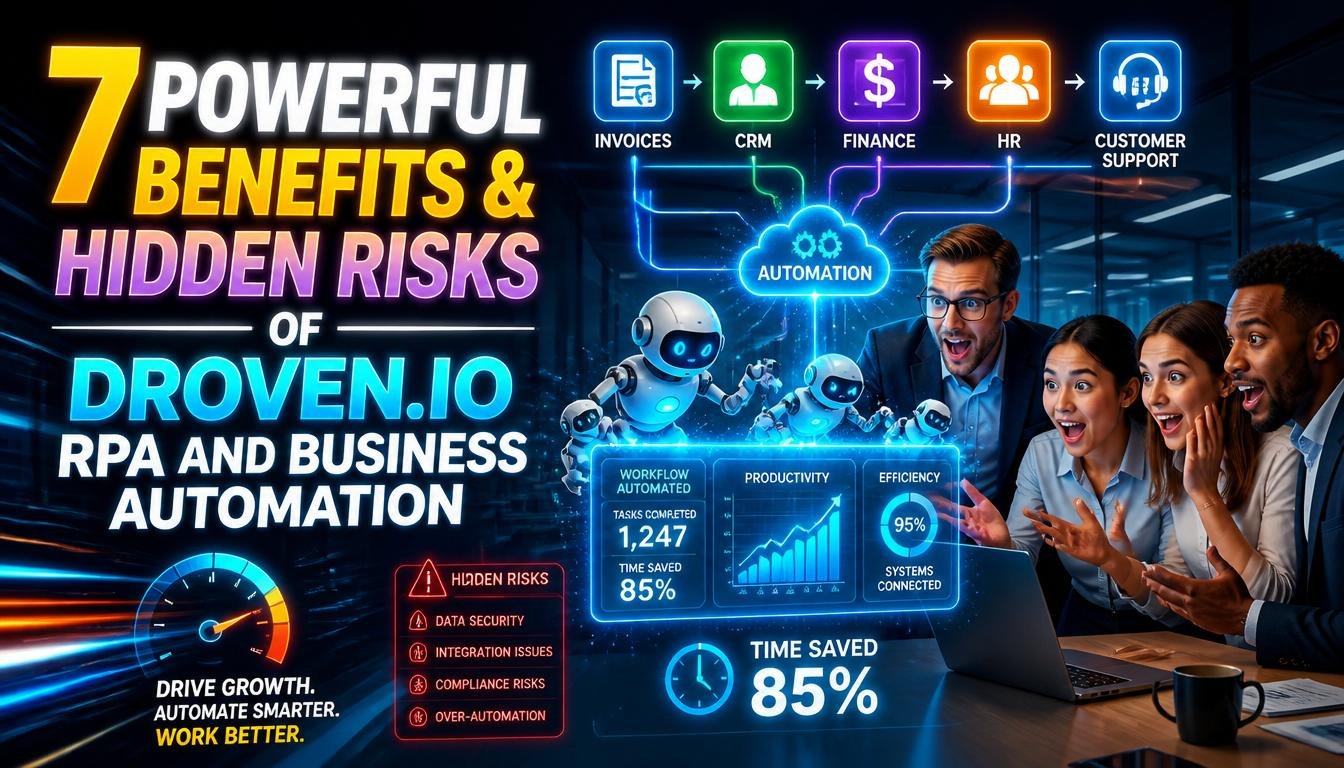
Droven.io RPA and Business Automation: The Complete Beginner’s Guide
Running a business takes time, energy, and careful planning. Many teams spend hours doing the same tasks every day. They copy data, update spreadsheets, send emails, check forms, and move information between different software. These jobs may look small, but together they take away valuable time that could be used for more important work.
That is why many companies now look at droven.io rpa and business automation as a smart way to improve daily work. Robotic Process Automation (RPA) uses software bots to complete rule-based digital tasks. Instead of replacing people, these bots help employees by handling repetitive work with speed and accuracy.
Business automation is much bigger than one software bot. It connects people, systems, and workflows to create smoother business operations. When used correctly, automation saves time, reduces manual mistakes, improves customer service, and helps businesses grow without adding unnecessary work.
In this complete guide, you will learn what droven.io rpa and business automation means, how it works, its benefits, common mistakes, practical examples, and the best ways to build successful automated workflows.
What Is Droven.io RPA and Business Automation?
Many people think automation is only for large companies, but that is no longer true. Today, businesses of every size use automation to remove repetitive work and improve efficiency. The phrase droven.io rpa and business automation is often discussed alongside digital transformation, artificial intelligence, workflow automation, and business innovation because it focuses on making everyday work easier.
Robotic Process Automation, or RPA, uses software bots instead of physical robots. These bots perform digital tasks by following clear instructions. For example, they can copy customer information, update databases, process invoices, create reports, send reminder emails, or move files between different systems. Since these tasks follow fixed rules, bots can complete them much faster than manual work while reducing common typing mistakes.
Business automation goes one step further. Instead of improving only one task, it connects many tasks into one complete workflow. Imagine a customer fills out an online form. The automation can automatically create a customer record, notify the sales team, send a welcome email, schedule a follow-up, and update the company dashboard without anyone needing to perform each step manually. This creates a smoother experience for both employees and customers.
One important thing to remember is that automation should support people rather than replace them. Human judgment is still needed when making business decisions, solving customer problems, or handling unusual situations. Automation works best when it removes repetitive work so employees have more time to focus on creative thinking, planning, and customer relationships. That balance is what makes modern business automation successful.
Why Businesses Are Choosing Droven.io RPA and Business Automation
Every business wants to complete work faster without reducing quality. As companies grow, manual work also increases. Employees often spend hours entering data, checking documents, updating records, preparing reports, and sending routine emails. These repetitive activities slow productivity and increase the chance of human error. This is one of the biggest reasons businesses are investing in droven.io rpa and business automation today.
A small online store offers a good example. Each day, new orders arrive from customers. Someone must confirm payment, update inventory, prepare invoices, notify the warehouse, and send shipping information. If everything is done manually, mistakes can happen during busy periods. However, automation can perform most of these tasks automatically within seconds, allowing employees to focus on customer support and business growth.
Another good example comes from human resources. When a new employee joins a company, HR usually collects documents, creates accounts, sends welcome emails, schedules training, and updates payroll records. Automation can complete many of these routine steps without delays. As a result, new employees receive a better onboarding experience while HR teams save many hours each week.
Experts also recommend starting with one simple workflow instead of trying to automate everything at once. Businesses that begin with one repetitive process can easily measure results, improve the workflow, and then expand automation to other departments. This gradual approach lowers risk, reduces costs, and helps employees feel comfortable using new technology. Over time, businesses enjoy faster operations, better accuracy, happier employees, and stronger customer satisfaction without making daily work more complicated.How Droven.io RPA and Business Automation Works in Daily Business
Every business follows a series of steps to complete its work. A customer places an order, an employee checks the details, the finance team confirms the payment, and the product is prepared for delivery. When these steps are done by hand, they take time and often lead to small mistakes. This is where droven.io rpa and business automation becomes useful. It helps businesses connect these tasks into one smooth workflow so work moves faster from start to finish.
Think about a company that receives hundreds of customer emails every day. Without automation, employees must open every email, read it, enter the details into a system, and send a reply. An RPA bot can do the repetitive part automatically. It can collect the customer’s information, save it in the correct system, send a welcome message, and notify the right department. Employees only need to handle special cases that require human thinking. As a result, the team works faster and customers receive quicker responses.
Another example is invoice processing. A finance team normally downloads invoices, checks the supplier’s details, enters the information into accounting software, and sends the invoice for approval. An automation workflow can complete most of these tasks within minutes. The software reads the invoice, matches the purchase order, updates the records, and alerts the manager for approval. This reduces manual work and helps avoid typing errors that may cause payment delays.
Experts often recommend reviewing a business process before automating it. If the workflow is already confusing, automation will only make the confusion happen faster. Therefore, businesses should first remove unnecessary steps, organize their data, and clearly define every task. Once the process becomes simple and easy to understand, automation delivers much better results. This practical approach creates reliable workflows that save time, improve teamwork, and support long-term business growth.
Top Benefits of Droven.io RPA and Business Automation for Every Business
One of the biggest reasons companies choose automation is the amount of time it saves. Employees no longer need to spend hours copying information between different programs or sending the same email again and again. Instead, software bots handle these repetitive tasks while employees focus on solving customer problems, creating new ideas, and growing the business. This improves both productivity and job satisfaction.
Automation also improves accuracy. People naturally make mistakes when repeating the same task many times, especially during busy workdays. A software bot follows the same rules every time without becoming tired or distracted. Because of this, businesses experience fewer data entry errors, fewer missing documents, and more reliable reports. Better accuracy also helps companies build trust with customers and reduce unnecessary costs caused by human mistakes.
Another important advantage is easier business growth. As companies gain more customers, manual work increases quickly. Hiring more employees for simple administrative work can become expensive. Automation allows businesses to manage larger workloads without adding the same amount of manual effort. In addition, managers can easily monitor workflow performance through reports and dashboards, making it easier to identify delays and improve operations over time.
An expert insight is that successful automation is not about replacing people—it is about giving people better work to do. Businesses that achieve the best results use automation to remove repetitive tasks while encouraging employees to focus on creativity, customer service, planning, and decision-making. Overall, this balanced approach creates stronger teams, happier customers, lower operating costs, and a business that is ready to grow in today’s digital world.Common Mistakes to Avoid When Using Droven.io RPA and Business Automation
Many businesses become excited about automation and try to automate every task at once. However, this usually creates confusion instead of improving productivity. A better approach is to begin with one simple workflow that follows clear rules. Once that process works well, the business can slowly automate other tasks. This method saves time, reduces risk, and allows employees to learn the new system step by step.
Another common mistake is using poor-quality data. Automation depends on the information it receives. If customer records are incomplete, invoices contain errors, or spreadsheets have incorrect values, the software will continue processing those mistakes. Therefore, businesses should clean their data before building any automation. Good data leads to better results, while poor data creates unnecessary problems.
Many companies also forget about security. Software bots often need permission to access customer information, financial records, and company systems. If businesses give bots too many permissions, they increase security risks. Instead, every bot should receive only the access it truly needs. Managers should also review activity logs regularly to make sure the automation continues working safely and correctly.
Plan Before You Automate
A successful automation project always begins with careful planning. Before creating any workflow, ask simple questions such as:
- What problem are we trying to solve?
- Which task happens every day?
- Does the task follow clear rules?
- Can the results be measured?
- Is human approval still needed?
Also, involve employees who perform the task every day. Their experience helps identify hidden problems that managers may not notice. On the other hand, ignoring employee feedback often leads to automation that looks good on paper but fails in real business situations.
Best Practices for Long-Term Success
Businesses that achieve the best results usually follow these simple practices:
- Start with one repetitive process.
- Test every workflow before launching it.
- Monitor performance every week.
- Update bots when software changes.
- Protect sensitive business data.
- Train employees to work alongside automation.
As a result, automation becomes a helpful business tool instead of a complicated technical project. Overall, steady improvement produces better long-term success than trying to automate everything immediately.
The Future of Droven.io RPA and Business Automation
Automation technology continues to improve every year. Today, businesses use software bots for simple rule-based work. In the future, these systems will become even smarter by working together with artificial intelligence, machine learning, and advanced business analytics. This means companies will complete work faster while making better decisions based on accurate data.
For example, imagine a customer contacting an online store with a delivery problem. Instead of only creating a support ticket, future automation could collect order details, check shipping status, prepare possible solutions, and send everything to the support agent before the conversation even begins. The employee still makes the final decision, but much of the routine work is already finished. Therefore, customers receive faster service and businesses improve overall satisfaction.
One expert insight is that companies should think of automation as a long-term business strategy instead of a one-time software purchase. Businesses that regularly review their workflows, improve weak processes, and train employees will gain much greater value than those that simply install software and expect instant success. Technology changes quickly, so successful companies continue learning and improving over time.
How to Start with Confidence
If your business is new to automation, follow these simple steps:
- Find one repetitive task.
- Measure how much time it takes today.
- Build a small automation.
- Test the results carefully.
- Improve the workflow if needed.
- Expand to another process only after success.
In addition, always keep people involved in important decisions. Automation works best when it supports human skills instead of replacing them.
Final Thoughts Before You Begin
Every business has repetitive work that slows progress. Some companies spend hours creating reports, updating spreadsheets, processing invoices, or sending reminder emails. Finally, automation helps remove these repetitive jobs so employees can focus on work that creates real value.
Overall, droven.io rpa and business automation is not about replacing people. It is about building smarter workflows that improve accuracy, save time, reduce costs, and create better customer experiences. Businesses that begin with small improvements today will be in a stronger position as technology continues to grow.
Conclusion
Modern businesses face increasing pressure to complete more work with fewer resources. Droven.io rpa and business automation provides a practical solution by handling repetitive digital tasks quickly and accurately. When businesses automate the right processes, they improve productivity, reduce manual errors, and allow employees to spend more time on creative thinking, customer service, and important decision-making.
The best automation projects always begin with one simple workflow, careful planning, and continuous improvement. Instead of trying to automate everything at once, businesses should build step by step while keeping human oversight where it matters most. With the right strategy, automation becomes a valuable partner that supports long-term growth, stronger teamwork, and better customer satisfaction.
FAQs
Q: What is droven.io rpa and business automation?
A: It refers to using software bots and automated workflows to reduce repetitive business tasks and improve efficiency.
Q: Is RPA only for large businesses?
A: No. Small, medium, and large businesses can all benefit from RPA and business automation.
Q: Can automation replace employees?
A: No. Automation handles repetitive tasks while employees focus on work that requires human thinking and creativity.
Q: Which business tasks are best for automation?
A: Data entry, invoice processing, customer onboarding, email reminders, reporting, payroll updates, and CRM management.
Q: How can businesses start using automation?
A: Start with one repetitive task, test the workflow carefully, measure results, and then expand gradually.
Q: What is the biggest mistake in automation?
A: Automating a broken process without improving it first. Always simplify the workflow before building automation.