
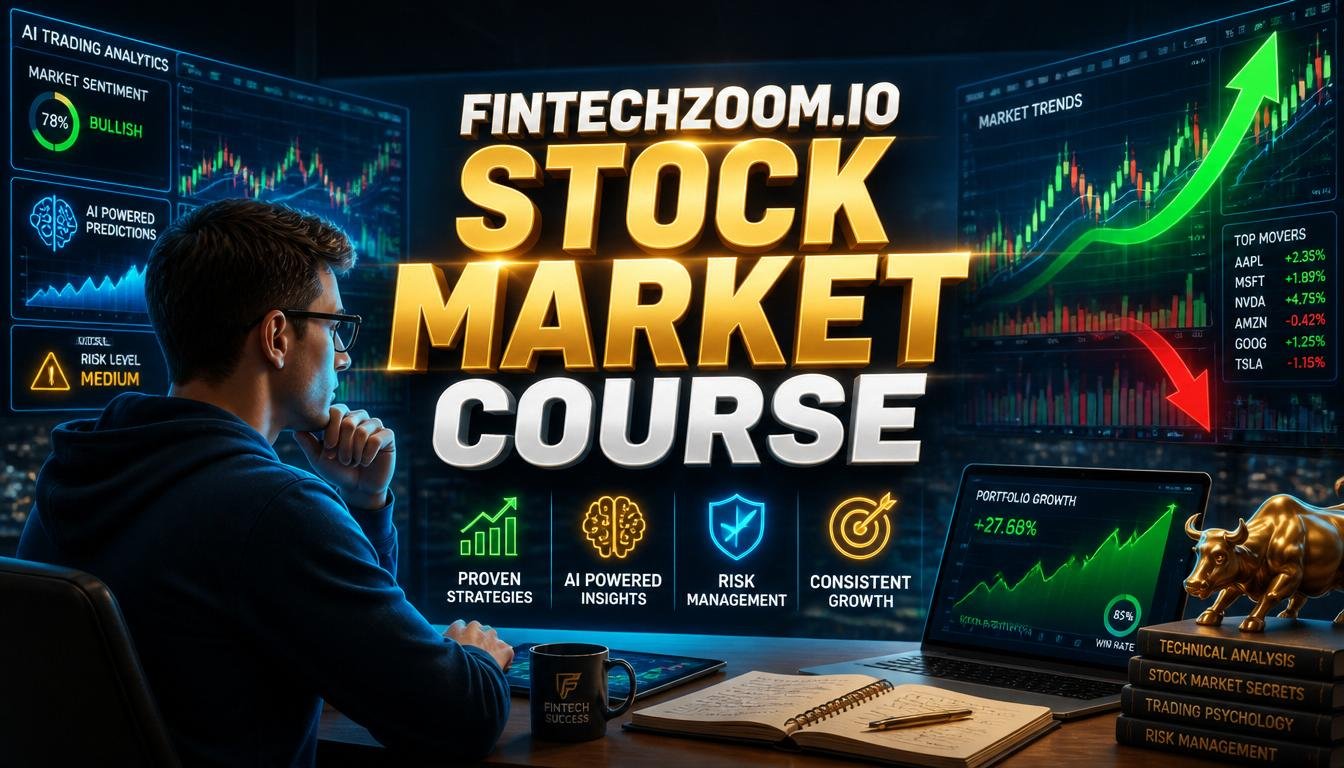
Fintechzoom.io Stock Market Course: Complete Beginner Guide
Learning the stock market can feel difficult when you are just getting started. Every day, thousands of people watch trading videos, read social media tips, and follow market influencers. The problem is that most of this information is unorganized. One video explains candlestick charts, another talks about options trading, while someone else tells you to buy a “hot stock.” Without a clear learning path, beginners often become confused before they even make their first investment.
That is why many new investors are searching for the fintechzoom.io stock market course. Instead of collecting information from dozens of websites, they want one place where they can learn the basics step by step. A structured course can help learners understand how the stock market works, how to manage risk, and how to make thoughtful decisions instead of emotional ones.
While public information about the course is limited and some details may change over time, the platform is widely known for publishing financial news, market updates, and investing content. The educational side aims to help people build financial knowledge in a simple and practical way. Rather than promising quick profits, the real goal of any good stock market course should be helping learners understand the market and develop better investing habits.
In this guide, we will explain what the fintechzoom.io stock market course is, who it is designed for, what you may learn, its possible advantages and limitations, and how to decide whether it matches your learning goals. We will also share practical tips that every beginner should know before spending money on any trading course.
Table of Contents
- What Is the Fintechzoom.io Stock Market Course?
- Why Are Online Stock Market Courses Becoming More Popular?
- What Can You Learn from the Course?
- Important Skills Every Beginner Should Build
- Benefits and Possible Drawbacks
- Is the Course Worth the Money?
- How to Learn Faster and Avoid Common Mistakes
- Final Thoughts
- Frequently Asked Questions
What Is the Fintechzoom.io Stock Market Course?
The stock market offers exciting opportunities, but it also comes with real risks. Many beginners lose confidence because they enter the market without understanding the basics. They hear terms like “bull market,” “support level,” “portfolio diversification,” or “risk management” and quickly feel overwhelmed. A structured learning program can make these topics much easier to understand by explaining them in the right order instead of expecting students to learn everything at once. The fintechzoom.io stock market course helps beginners understand the basics of investing.
The fintechzoom.io stock market course is designed for people who want to build a stronger understanding of investing and trading through guided lessons instead of random online advice. Based on publicly available descriptions, the educational content focuses on helping learners understand market fundamentals, technical analysis, investing principles, and practical decision-making. The goal is not simply to teach financial terms but to help students understand why prices move, how investors think, and how risk can be managed more effectively.
One of the biggest advantages of learning through a structured course is consistency. Free content on the internet can certainly be helpful, but it is often incomplete. A beginner might learn about indicators before understanding basic market trends or study trading strategies before learning how to protect their capital. A step-by-step learning path helps students build knowledge naturally, making each new lesson easier to understand than the last.
Another important point is that education should improve decision-making rather than promise guaranteed profits. No trading course can remove market risk or predict future stock prices with complete accuracy. Instead, the value of a course comes from teaching better habits, improving financial knowledge, and helping learners become more confident when analyzing investment opportunities. For most beginners, developing patience, discipline, and realistic expectations is often more valuable than finding the next “winning stock.”
As financial technology continues to grow, more people prefer learning online because they can study whenever they have free time. Whether someone is a university student, a full-time employee, or simply interested in building long-term wealth, online learning provides flexibility that traditional classroom education cannot always offer. This convenience is one reason why educational platforms covering investing and trading continue to attract attention from people around the world.Why Are Online Stock Market Courses Becoming More Popular?
The way people learn has changed a lot over the last few years. In the past, learning about the stock market usually meant reading large finance books or attending expensive seminars. Today, anyone with a laptop or smartphone can start learning from home. This change has made online stock market education more popular than ever. Many beginners now choose the fintechzoom.io stock market course because they want a simple learning path instead of spending hours searching for free information that may not be accurate.
Another reason for this growing popularity is flexibility. Most people have busy lives filled with work, school, or family responsibilities. They cannot attend fixed classes every week. An online course allows learners to study whenever they have free time. Some people prefer learning early in the morning, while others study after work or on weekends. This freedom makes learning less stressful and easier to fit into everyday life. Students can also repeat difficult lessons until they fully understand the topic.
Online courses also help beginners avoid one of the biggest mistakes in investing—following random advice from social media. Every day, thousands of videos promise quick profits and easy success. While some creators share useful tips, others focus only on getting views. New investors often become confused because different people give different advice. A structured course helps learners understand the reasons behind each trading decision instead of copying someone else’s strategy. This creates confidence and encourages independent thinking.
Another benefit is the growing use of technology in financial education. Many online platforms now include videos, charts, quizzes, practice exercises, and downloadable study materials. These learning tools make complex topics easier to understand. Instead of reading long paragraphs full of difficult financial terms, students can see visual examples that explain market movements in a simple way. Interactive learning also keeps people engaged for longer periods, helping them remember important concepts more easily.
The rise of online investing has also encouraged more people to improve their financial knowledge. Mobile trading apps have made buying and selling stocks much easier than before. However, easy access to the market does not automatically create successful investors. Without proper education, beginners may make emotional decisions that lead to unnecessary losses. Learning the basics before investing real money helps reduce this risk and builds stronger long-term habits.
Real-life examples show why education matters. Imagine two friends who each invest the same amount of money. One spends time learning about diversification, company research, and risk management before investing. The other follows trending stocks on social media without understanding why prices are moving. Over time, the first investor is more likely to make calm and informed decisions, while the second may panic during market ups and downs. Knowledge cannot remove market risk, but it often improves the quality of investment decisions.
What Can You Learn from the Fintechzoom.io Stock Market Course?
One of the biggest questions beginners ask is what they will actually learn after joining a trading course. The answer depends on the course structure, but a good program should focus on building practical knowledge rather than teaching complicated financial theories. According to publicly available information, the fintechzoom.io stock market course aims to help learners understand the foundations of investing before moving toward more advanced topics. This gradual approach makes learning easier for people with little or no previous experience.
The first lessons usually focus on understanding how the stock market works. Students learn what stocks represent, why companies sell shares, and how stock exchanges operate. They also become familiar with common investing terms such as dividends, market capitalization, volatility, and liquidity. These basic concepts create a strong foundation that supports later lessons. Without understanding these ideas, it becomes much harder to learn chart analysis or trading strategies.
As learners gain confidence, they are introduced to market analysis. This generally includes understanding price charts, identifying trends, recognizing support and resistance levels, and learning how investors use technical indicators. At the same time, students may also explore the basics of fundamental analysis by looking at company performance, financial reports, business growth, and economic news. Studying both technical and fundamental methods gives learners a broader view of how investment decisions are made.
Risk management is another essential topic. Many beginners spend most of their time searching for profitable trades but forget to learn how to protect their money. Good investing is not only about finding opportunities—it is also about limiting losses when markets move in the wrong direction. Students are encouraged to think about position sizing, diversification, realistic expectations, and emotional discipline. These habits can make a significant difference over the long term because preserving capital is just as important as growing it.
The course may also introduce learners to different investing styles. Some people enjoy active trading and monitor the market every day, while others prefer long-term investing by holding quality companies for many years. Understanding these different approaches helps students choose a strategy that matches their goals, available time, and comfort with risk. Instead of copying someone else’s method, they can begin developing their own investing style based on knowledge and careful planning.
Perhaps the most valuable lesson is learning to think independently. Successful investors rarely make decisions based only on rumors or social media trends. They gather information, study market conditions, compare different opportunities, and remain patient during uncertain times. Building this mindset takes practice, but it is one of the most important skills any educational program can encourage. Rather than chasing quick profits, learners begin focusing on making informed decisions that support long-term financial growth.Important Skills Every Beginner Should Build
Starting your investing journey is exciting, but success in the stock market does not come from luck alone. It comes from learning the right skills and using them with patience. While many people join the fintechzoom.io stock market course hoping to find the perfect trading strategy, the real value of any educational program is helping learners develop strong habits. These habits can improve decision-making and reduce common beginner mistakes over time.
The first skill every investor should build is market understanding. Before buying any stock, it is important to know why prices move. Company earnings, economic news, interest rates, business growth, and global events can all affect the market. Learning these basics helps beginners avoid emotional decisions. Instead of reacting to every price change, they begin to understand the bigger picture and make more thoughtful choices.
Another important skill is chart reading. Price charts may look confusing at first, but they become much easier with practice. Beginners should learn how to identify trends, support levels, resistance levels, and simple candlestick patterns. These tools do not predict the future, but they can help investors understand how buyers and sellers are behaving. Combined with company research, chart analysis becomes a useful part of the decision-making process instead of a guessing game.
Risk management is one of the most valuable lessons in investing. Many experienced traders believe protecting your money is even more important than making profits. Beginners should learn how much money to invest in one trade, when to accept a small loss, and why diversification matters. Putting all your money into a single company can be risky, while spreading investments across different sectors may reduce the impact of market swings.
Emotional control is another skill that is often overlooked. Markets move up and down every day, and fear or excitement can easily influence decisions. A disciplined investor follows a plan instead of reacting to short-term emotions. Keeping a trading journal, reviewing past decisions, and learning from mistakes are simple habits that can improve confidence over time. Real progress usually comes from consistency rather than trying to make quick profits overnight.
A real-life example shows why these skills matter. Imagine two beginners with the same amount of money. One studies the market, researches companies, manages risk, and follows a simple investment plan. The other buys stocks only because they are trending online. After several months, the first investor is more likely to understand why investments succeed or fail, while the second may struggle to learn from mistakes. Knowledge does not guarantee profits, but it gives investors a stronger foundation for making smart financial decisions.
Benefits and Possible Drawbacks
Every online learning program has strengths and weaknesses, and the fintechzoom.io stock market course is no exception. Before joining any educational platform, it is important to understand both the advantages and the possible limitations. Looking at both sides helps learners make realistic decisions instead of expecting perfect results.
One of the biggest benefits is having a structured learning path. Many beginners spend weeks jumping between YouTube videos, blogs, podcasts, and social media posts without understanding how everything connects. A well-organized course places lessons in the correct order so students can move from basic concepts to more advanced topics step by step. This saves time and reduces confusion, especially for people who have never invested before.
Another advantage is flexibility. Online learning allows students to study at their own pace. Busy professionals, university students, and parents can learn whenever they have free time. Instead of following a fixed classroom schedule, they can pause lessons, review important topics, and continue learning whenever it is convenient. This makes online education much more practical for many people around the world.
The course may also encourage better investing habits. Rather than chasing quick profits, learners are introduced to concepts such as research, planning, diversification, and long-term thinking. These habits can help investors become more patient and disciplined. Even if someone decides not to become an active trader, understanding how financial markets work can improve personal financial decisions and increase confidence when managing investments.
However, there are also some important limitations to consider. No online course can guarantee financial success. Stock markets are influenced by changing economic conditions, company performance, and unexpected global events. Even experienced investors sometimes make mistakes or experience losses. Education improves knowledge, but it cannot remove uncertainty from investing.
Another possible drawback is that beginners may expect too much from a single course. Learning about investing is a continuous process that requires practice, reading, observation, and experience. Completing one course is only the beginning. Students should continue following financial news, studying businesses, and reviewing their own investment decisions if they want to improve over time.
The best way to measure the value of a course is not by asking whether it will make you rich. A better question is whether it helps you understand the market more clearly, avoid common mistakes, and make better financial decisions. If a course can achieve those goals, it has already provided meaningful value, even though long-term investing success will always depend on the learner’s effort, patience, and discipline.Is the Fintechzoom.io Stock Market Course Worth Your Time and Money?
Choosing the right stock market course is an important decision. There are hundreds of online courses that promise to teach trading, but not all of them provide real value. Before spending your money, it is smart to compare the course content, learning style, and your personal goals. The fintechzoom.io stock market course may be a suitable option for beginners who want a simple introduction to investing, but it should not be viewed as a shortcut to becoming a successful trader.
If you are completely new to the stock market, a structured course can save you many hours of confusion. Instead of jumping between different websites and YouTube videos, you follow one learning path from beginning to end. This helps you understand important topics such as stock market basics, technical analysis, risk management, and investment planning. A beginner who learns these fundamentals is usually in a much better position than someone who relies only on random online advice.
However, every learner should have realistic expectations. No online course can guarantee profits because the stock market changes every day. Economic news, company earnings, inflation, interest rates, and global events can all affect stock prices. Even professional investors experience losses. A course should therefore be seen as an educational investment rather than a promise of financial success. The knowledge you gain can improve your decisions, but your results will always depend on your research, discipline, and patience.
Another point to consider is your learning style. Some people enjoy watching video lessons, while others prefer reading books or practicing with demo trading accounts. Before joining any course, think about how you learn best. If you enjoy following step-by-step lessons and practicing regularly, you are more likely to benefit from a structured learning program.
The true value of the fintechzoom.io stock market course depends on how you use the knowledge after completing it. Students who continue reading financial news, studying companies, practicing chart analysis, and reviewing their investment decisions usually improve much faster than those who simply finish the lessons and stop learning. In investing, education is a lifelong journey rather than a one-time event.
How to Get the Best Results from the Course
Improving your investing skills takes more than simply watching lessons. The best learners actively practice what they study and continue building their knowledge every week. If you decide to explore the fintechzoom.io stock market course, creating a simple learning routine can help you understand concepts more clearly and remember them for the long term.
Create a Weekly Study Plan
A regular schedule makes learning easier. Even 30 to 45 minutes each day can produce better results than studying for many hours only once a month.
You can follow a simple routine like this:
- Learn one new topic each week.
- Review your notes before starting the next lesson.
- Practice reading real stock charts.
- Follow financial news every day.
- Spend time understanding why stock prices move.
Small daily improvements often lead to much better results than trying to learn everything at once.
Practice Before Investing Real Money
Learning becomes much more effective when you apply your knowledge. Many beginners rush into buying stocks without enough preparation. A safer approach is to practice first.
Helpful ways to build confidence include:
- Use a paper trading or demo account.
- Track a few companies every week.
- Compare market news with price movements.
- Keep a notebook of your investment ideas.
- Review both successful and unsuccessful decisions.
These simple habits help you understand the market without risking large amounts of money too early.
Keep Learning Beyond the Course
One course cannot teach everything about investing. Financial markets continue changing every year, and successful investors continue learning throughout their lives.
You can improve your knowledge by:
- Reading trusted financial websites.
- Following company earnings reports.
- Learning basic economic indicators.
- Reading books written by experienced investors.
- Reviewing your portfolio regularly.
The goal is not to become perfect overnight. Instead, focus on making slightly better decisions each month. Over time, these improvements can build strong investing skills and greater confidence.
Conclusion
Learning about the stock market is one of the best long-term investments you can make in yourself. The fintechzoom.io stock market course may offer a helpful starting point for beginners who want a structured way to understand investing instead of relying on random online advice. A clear learning path can make difficult topics easier to understand and help new investors build confidence before investing real money.
At the same time, remember that no course can replace patience, practice, and real-world experience. Successful investing comes from continuous learning, careful research, and good risk management. Whether you choose this course or another educational program, focus on building knowledge first and chasing profits second. A strong financial foundation will always be more valuable than looking for shortcuts.
Frequently Asked Questions
Q: Is the fintechzoom.io stock market course suitable for complete beginners?
A: Yes. Based on publicly available information, it is aimed at people who want to learn stock market basics in a structured way.
Q: Does the course guarantee trading profits?
A: No. No legitimate stock market course can guarantee profits because financial markets are always changing.
Q: How long does it take to finish the course?
A: The time depends on the learning pace and the available course material. Learners should check the platform for the latest details.
Q: Can experienced investors also benefit from the course?
A: Some intermediate investors may find value in reviewing core concepts and improving their investing discipline.
Q: What is the biggest advantage of learning through a structured course?
A: A structured course organizes topics in the correct order, making learning easier than relying on random online resources.
Q: Should beginners invest real money immediately after completing a course?
A: It is usually better to practice with a demo account, continue learning, and invest carefully only after building confidence and understanding the risks.