

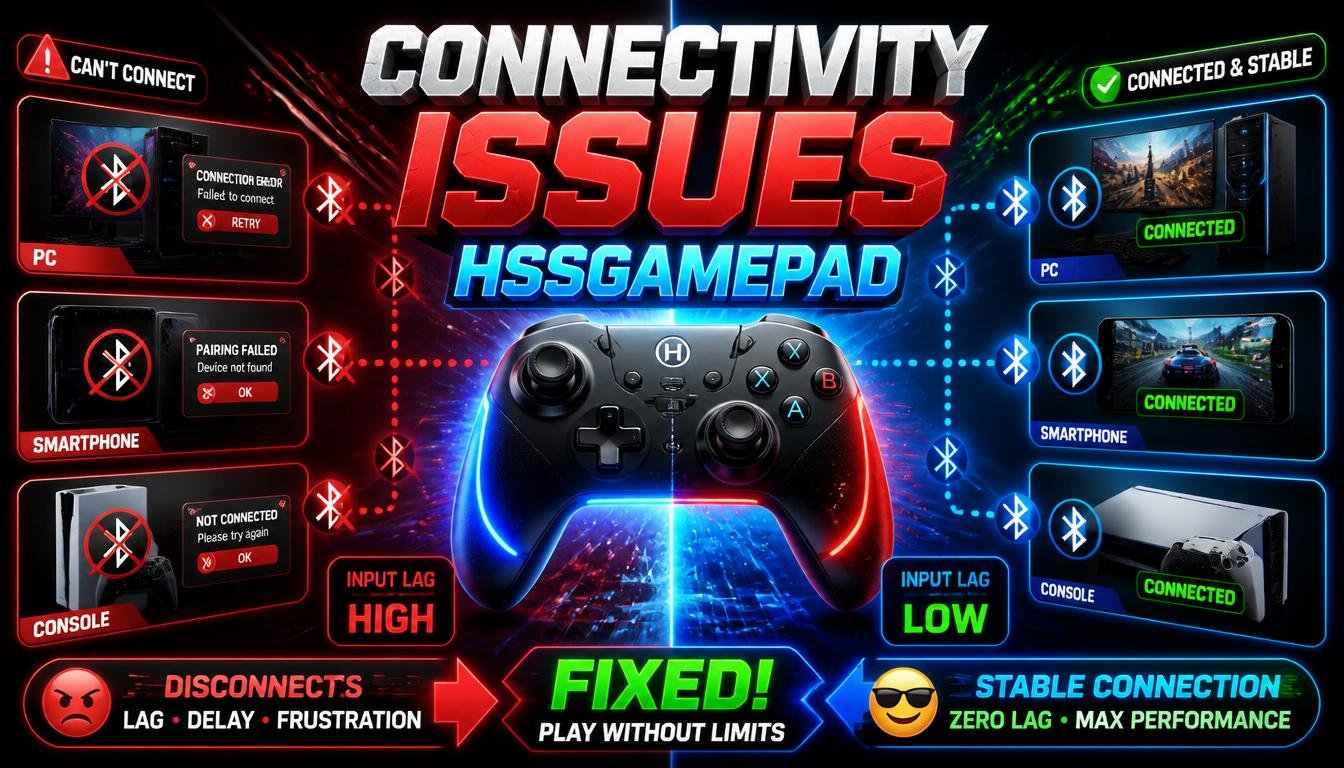
Connectivity Issues HSSGamepad: Complete Beginner’s Guide to Easy Fixes
Have you ever been excited to play your favorite game, only to find that your controller will not connect? It can feel very frustrating when your game stops because of a simple connection problem. Many players experience connectivity issues hssgamepad at some point, whether they use a PC, Android phone, iPhone, tablet, or gaming console. The good news is that most of these problems are easy to fix if you know where to look.
The HSSGamepad is made to give players a smooth and comfortable gaming experience. Most connectivity issues hssgamepad can be solved by following a few simple troubleshooting steps. It supports wireless Bluetooth connections, wired USB connections, and works with different types of devices. Most of the time, it performs very well. However, things like low battery, software bugs, Bluetooth interference, or outdated drivers can make the controller lose its connection or respond slowly.
Many people think their controller is broken when it suddenly disconnects. In reality, the problem is often caused by a small setting or a simple software issue. A quick restart, fresh pairing, or software update can solve the problem within a few minutes. Understanding the real cause helps you avoid wasting time and money.
In this complete guide, you will learn everything about connectivity issues hssgamepad This guide also explains how to prevent connectivity issues hssgamepad in the future. in simple English. We will explain why these problems happen, how to fix them step by step, how to improve gaming performance, and how to prevent future connection problems. Whether you are a beginner or an experienced gamer, this guide will help you enjoy smooth and stable gameplay.
Why Connectivity Issues HSSGamepad Happen
Every wireless controller depends on good communication between the gamepad and your device. When this communication becomes weak or breaks completely, you may notice delays, failed pairing, random disconnections, or buttons that stop responding. Connectivity issues hssgamepad usually happen because of small problems that are easy to solve once you understand them.
Bluetooth is one of the most common ways to connect an HSSGamepad. Bluetooth works by sending wireless signals between the controller and your device. These signals can become weaker when there are many wireless devices nearby. Wi-Fi routers, wireless speakers, smart TVs, keyboards, and even other controllers may create interference. As a result, the connection may become unstable during gameplay.
Battery health is another important factor that many players ignore. Many connectivity issues hssgamepad start because of low battery power. A controller with a low battery may not have enough power to maintain a strong wireless signal. This can lead to sudden disconnections or slow button responses. Before trying advanced fixes, always make sure your controller is fully charged. Using the original charging cable can also help keep the battery in good condition.
Software problems are also very common. Understanding connectivity issues hssgamepad helps gamers fix problems much faster. Your computer, phone, or console uses drivers and firmware to communicate with the controller. If these files become outdated or damaged, the connection may stop working properly. Installing the latest updates often improves compatibility, fixes bugs, and increases connection stability.
Different devices may also support controllers in different ways. Some older smartphones or computers may not fully support all controller features. This can make pairing difficult or prevent certain buttons from working correctly. Checking device compatibility before connecting your controller can save time and reduce frustration.
Distance also plays a big role in wireless performance. Bluetooth connections work best when the controller stays close to the device. Large walls, furniture, or even your body can block wireless signals. Keeping the controller within the recommended range helps maintain a strong connection and reduces input delay.
Environmental conditions matter as well. Crowded wireless environments, such as offices, gaming events, or homes with many smart devices, create more signal traffic. This increases the chance of temporary connection drops. Reducing the number of active Bluetooth devices nearby often improves performance immediately.
Real-life experience shows how simple many of these fixes can be. For example, one player believed their controller had stopped working after it disconnected every few minutes. After charging the battery fully and moving the Wi-Fi router farther away from the gaming desk, the controller worked perfectly again without needing any repairs.
Understanding these causes makes troubleshooting much easier. Instead of guessing or replacing your controller, you can identify the real issue and apply the correct solution. In the next section, we will explore the most common signs of connectivity issues hssgamepad and explain what each one means so you can solve the problem faster.
Common Signs of Connectivity Issues HSSGamepad and What They Mean
When your controller does not work as expected, it usually gives you small warning signs before the problem becomes serious. Learning to recognize these signs can help you fix connectivity issues hssgamepad much faster. Instead of trying random solutions, you can understand what the controller is telling you and choose the right fix. Most connection problems follow similar patterns, making them easier to diagnose than many people think.
One of the most common signs is that the controller refuses to pair with your device. You may put the HSSGamepad into pairing mode, but your PC, phone, or console cannot find it. Sometimes the controller appears in the Bluetooth list but disappears after a few seconds. This often happens because Bluetooth is turned off, the controller is already connected to another device, or the pairing information has become corrupted. Removing the old pairing and starting again usually solves this issue.
Another common symptom is random disconnections during gameplay. Imagine playing an exciting racing game or fighting an important battle when the controller suddenly disconnects. Your character stops moving, and the game becomes difficult to control. These disconnects often happen because of a weak battery, wireless interference, or being too far from the connected device. Keeping the controller charged and staying within Bluetooth range can greatly improve connection stability.
Input lag is another problem that many gamers notice. Input lag is one of the most common connectivity issues hssgamepad users experience.
Input lag means there is a delay between pressing a button and seeing the action on the screen. Even a delay of a fraction of a second can make games feel slow and less enjoyable. This issue is especially noticeable in sports games, racing games, shooting games, and action titles where quick reactions matter. Background apps, crowded wireless networks, and outdated drivers are common reasons for delayed responses.
Sometimes the controller connects successfully but does not work inside the game. Your computer may show that the controller is connected, yet the buttons, triggers, or joysticks do nothing. In some cases, only a few buttons respond while others remain inactive. This usually points to driver problems, incorrect controller settings, or games that require manual controller configuration before use.
Players may also notice that the controller repeatedly connects and disconnects Repeated disconnects are another sign of connectivity issues hssgamepad. every few minutes. This continuous reconnecting can interrupt gameplay and become very frustrating. A damaged USB cable, unstable Bluetooth signal, or low battery level often causes this behavior. Testing another cable or switching to a different USB port can quickly identify whether the problem is hardware related.
Another warning sign is poor wireless range. Normally, the HSSGamepad should work smoothly from several meters away. If it disconnects after moving only a short distance, nearby wireless devices or physical obstacles may be weakening the signal. Moving closer to the device or reducing interference often restores normal performance.
Real-life examples make these situations easier to understand. A student using an HSSGamepad with a laptop noticed heavy input lag every evening but not during the day. After checking the room, they realized several family members were using multiple Wi-Fi devices at the same time. Moving closer to the laptop and disconnecting unused Bluetooth accessories reduced the interference, making the controller responsive again.
It is also important to pay attention to LED indicator lights on the controller. A flashing light usually means the controller is searching for a device or waiting to pair. A steady light often indicates a successful connection, while unusual blinking patterns may point to low battery or pairing errors. Reading these signals can save time during troubleshooting.
By recognizing these early warning signs, you can solve problems before they become more serious. Most users discover that the controller itself is working correctly, and only the connection needs attention. Once you understand what each symptom means, fixing the issue becomes much easier and much faster.
Basic Solutions to Fix Connectivity Issues HSSGamepad
The good news is that many connectivity issues hssgamepad can be fixed without technical knowledge. In fact, most problems are solved using a few simple troubleshooting steps that take only a few minutes. Before assuming that your controller is damaged, it is always best to try these basic fixes first. They are safe, easy to perform, and often restore a stable connection immediately.
The first step is restarting both the HSSGamepad and the device you are using. Temporary software glitches sometimes prevent proper communication between the controller and your PC, smartphone, tablet, or console. Turn off both devices completely, wait for about 30 seconds, and then power them back on. This simple restart refreshes the connection and clears many temporary errors.
Next, remove the controller from your device’s Bluetooth list and pair it again from the beginning. Old or damaged pairing information can stop the controller from connecting properly. Open your Bluetooth settings, select the HSSGamepad, choose Forget Device, and then place the controller back into pairing mode. A fresh connection often fixes pairing failures and unexpected disconnects.
Battery level should always be checked before trying advanced troubleshooting. A weak battery can reduce Bluetooth signal strength and make the controller disconnect without warning. Charge the controller fully using a reliable charging cable. If possible, allow it to reach 100% before testing the connection again.
You should also confirm that Bluetooth is working correctly on your device. Try connecting another Bluetooth accessory, such as wireless headphones or a keyboard. If that device also fails to connect, the problem may be with the computer or phone rather than the controller itself. Restarting Bluetooth services or updating the operating system may solve the issue.
If you are using a wired connection, inspect the USB cable carefully. A loose, damaged, or poor-quality cable can interrupt communication between the controller and the device. Try another cable and connect it to a different USB port. Many users solve connection problems simply by replacing an old cable.
Software updates are another simple but powerful solution. Device manufacturers regularly release firmware and driver updates to improve compatibility and fix connection bugs. Keeping your operating system and controller software updated helps maintain reliable performance across different platforms.
Finally, reduce wireless interference whenever possible. Move the controller closer to the connected device, keep it away from Wi-Fi routers, and disconnect Bluetooth devices that you are not using. These small adjustments often improve signal quality and reduce lag without changing any settings.
These basic troubleshooting methods solve a large number of connection problems. If the issue still continues after trying all of them, the next section will cover advanced troubleshooting techniques that can fix more difficult connectivity problems and improve overall gaming performance.Common Signs of Connectivity Issues HSSGamepad and What They Mean
When your controller does not work as expected, it usually gives you small warning signs before the problem becomes serious. Learning to recognize these signs can help you fix connectivity issues hssgamepad much faster. Instead of trying random solutions, you can understand what the controller is telling you and choose the right fix. Most connection problems follow similar patterns, making them easier to diagnose than many people think.
One of the most common signs is that the controller refuses to pair with your device. You may put the HSSGamepad into pairing mode, but your PC, phone, or console cannot find it. Sometimes the controller appears in the Bluetooth list but disappears after a few seconds. This often happens because Bluetooth is turned off, the controller is already connected to another device, or the pairing information has become corrupted. Removing the old pairing and starting again usually solves this issue.
Another common symptom is random disconnections during gameplay. Imagine playing an exciting racing game or fighting an important battle when the controller suddenly disconnects. Your character stops moving, and the game becomes difficult to control. These disconnects often happen because of a weak battery, wireless interference, or being too far from the connected device. Keeping the controller charged and staying within Bluetooth range can greatly improve connection stability.
Input lag is another problem that many gamers notice. Input lag means there is a delay between pressing a button and seeing the action on the screen. Even a delay of a fraction of a second can make games feel slow and less enjoyable. This issue is especially noticeable in sports games, racing games, shooting games, and action titles where quick reactions matter. Background apps, crowded wireless networks, and outdated drivers are common reasons for delayed responses.
Sometimes the controller connects successfully but does not work inside the game. Your computer may show that the controller is connected, yet the buttons, triggers, or joysticks do nothing. In some cases, only a few buttons respond while others remain inactive. This usually points to driver problems, incorrect controller settings, or games that require manual controller configuration before use.
Players may also notice that the controller repeatedly connects and disconnects every few minutes. This continuous reconnecting can interrupt gameplay and become very frustrating. A damaged USB cable, unstable Bluetooth signal, or low battery level often causes this behavior. Testing another cable or switching to a different USB port can quickly identify whether the problem is hardware related.
Another warning sign is poor wireless range. Normally, the HSSGamepad should work smoothly from several meters away. If it disconnects after moving only a short distance, nearby wireless devices or physical obstacles may be weakening the signal. Moving closer to the device or reducing interference often restores normal performance.
Real-life examples make these situations easier to understand. A student using an HSSGamepad with a laptop noticed heavy input lag every evening but not during the day. After checking the room, they realized several family members were using multiple Wi-Fi devices at the same time. Moving closer to the laptop and disconnecting unused Bluetooth accessories reduced the interference, making the controller responsive again.
It is also important to pay attention to LED indicator lights on the controller. A flashing light usually means the controller is searching for a device or waiting to pair. A steady light often indicates a successful connection, while unusual blinking patterns may point to low battery or pairing errors. Reading these signals can save time during troubleshooting.
By recognizing these early warning signs, you can solve problems before they become more serious. Most users discover that the controller itself is working correctly, and only the connection needs attention. Once you understand what each symptom means, fixing the issue becomes much easier and much faster.
Basic Solutions to Fix Connectivity Issues HSSGamepad
The good news is that many connectivity issues hssgamepad can be fixed without technical knowledge. In fact, most problems are solved using a few simple troubleshooting steps that take only a few minutes. Before assuming that your controller is damaged, it is always best to try these basic fixes first. They are safe, easy to perform, and often restore a stable connection immediately.
The first step is restarting both the HSSGamepad and the device you are using. Temporary software glitches sometimes prevent proper communication between the controller and your PC, smartphone, tablet, or console. Turn off both devices completely, wait for about 30 seconds, and then power them back on. This simple restart refreshes the connection and clears many temporary errors.
Next, remove the controller from your device’s Bluetooth list and pair it again from the beginning. Old or damaged pairing information can stop the controller from connecting properly. Open your Bluetooth settings, select the HSSGamepad, choose Forget Device, and then place the controller back into pairing mode. A fresh connection often fixes pairing failures and unexpected disconnects.
Battery level should always be checked before trying advanced troubleshooting. A weak battery can reduce Bluetooth signal strength and make the controller disconnect without warning. Charge the controller fully using a reliable charging cable. If possible, allow it to reach 100% before testing the connection again.
You should also confirm that Bluetooth is working correctly on your device. Try connecting another Bluetooth accessory, such as wireless headphones or a keyboard. If that device also fails to connect, the problem may be with the computer or phone rather than the controller itself. Restarting Bluetooth services or updating the operating system may solve the issue.
If you are using a wired connection, inspect the USB cable carefully. A loose, damaged, or poor-quality cable can interrupt communication between the controller and the device. Try another cable and connect it to a different USB port. Many users solve connection problems simply by replacing an old cable.
Software updates are another simple but powerful solution. Device manufacturers regularly release firmware and driver updates to improve compatibility and fix connection bugs. Keeping your operating system and controller software updated helps maintain reliable performance across different platforms.
Finally, reduce wireless interference whenever possible. Move the controller closer to the connected device, keep it away from Wi-Fi routers, and disconnect Bluetooth devices that you are not using. These small adjustments often improve signal quality and reduce lag without changing any settings.
These basic troubleshooting methods solve a large number of connection problems. If the issue still continues after trying all of them, the next section will cover advanced troubleshooting techniques that can fix more difficult connectivity problems and improve overall gaming performance.Common Signs of Connectivity Issues HSSGamepad and What They Mean
When your controller does not work as expected, it usually gives you small warning signs before the problem becomes serious. Learning to recognize these signs can help you fix connectivity issues hssgamepad much faster. Instead of trying random solutions, you can understand what the controller is telling you and choose the right fix. Most connection problems follow similar patterns, making them easier to diagnose than many people think.
One of the most common signs is that the controller refuses to pair with your device. You may put the HSSGamepad into pairing mode, but your PC, phone, or console cannot find it. Sometimes the controller appears in the Bluetooth list but disappears after a few seconds. This often happens because Bluetooth is turned off, the controller is already connected to another device, or the pairing information has become corrupted. Removing the old pairing and starting again usually solves this issue.
Another common symptom is random disconnections during gameplay. Imagine playing an exciting racing game or fighting an important battle when the controller suddenly disconnects. Your character stops moving, and the game becomes difficult to control. These disconnects often happen because of a weak battery, wireless interference, or being too far from the connected device. Keeping the controller charged and staying within Bluetooth range can greatly improve connection stability.
Input lag is another problem that many gamers notice. Input lag means there is a delay between pressing a button and seeing the action on the screen. Even a delay of a fraction of a second can make games feel slow and less enjoyable. This issue is especially noticeable in sports games, racing games, shooting games, and action titles where quick reactions matter. Background apps, crowded wireless networks, and outdated drivers are common reasons for delayed responses.
Sometimes the controller connects successfully but does not work inside the game. Your computer may show that the controller is connected, yet the buttons, triggers, or joysticks do nothing. In some cases, only a few buttons respond while others remain inactive. This usually points to driver problems, incorrect controller settings, or games that require manual controller configuration before use.
Players may also notice that the controller repeatedly connects and disconnects every few minutes. This continuous reconnecting can interrupt gameplay and become very frustrating. A damaged USB cable, unstable Bluetooth signal, or low battery level often causes this behavior. Testing another cable or switching to a different USB port can quickly identify whether the problem is hardware related.
Another warning sign is poor wireless range. Normally, the HSSGamepad should work smoothly from several meters away. If it disconnects after moving only a short distance, nearby wireless devices or physical obstacles may be weakening the signal. Moving closer to the device or reducing interference often restores normal performance.
Real-life examples make these situations easier to understand. A student using an HSSGamepad with a laptop noticed heavy input lag every evening but not during the day. After checking the room, they realized several family members were using multiple Wi-Fi devices at the same time. Moving closer to the laptop and disconnecting unused Bluetooth accessories reduced the interference, making the controller responsive again.
It is also important to pay attention to LED indicator lights on the controller. A flashing light usually means the controller is searching for a device or waiting to pair. A steady light often indicates a successful connection, while unusual blinking patterns may point to low battery or pairing errors. Reading these signals can save time during troubleshooting.
By recognizing these early warning signs, you can solve problems before they become more serious. Most users discover that the controller itself is working correctly, and only the connection needs attention. Once you understand what each symptom means, fixing the issue becomes much easier and much faster.
Basic Solutions to Fix Connectivity Issues HSSGamepad
The good news is that many connectivity issues hssgamepad can be fixed without technical knowledge. In fact, most problems are solved using a few simple troubleshooting steps that take only a few minutes. Before assuming that your controller is damaged, it is always best to try these basic fixes first. They are safe, easy to perform, and often restore a stable connection immediately.
The first step is restarting both the HSSGamepad and the device you are using. Temporary software glitches sometimes prevent proper communication between the controller and your PC, smartphone, tablet, or console. Turn off both devices completely, wait for about 30 seconds, and then power them back on. This simple restart refreshes the connection and clears many temporary errors.
Next, remove the controller from your device’s Bluetooth list and pair it again from the beginning. Old or damaged pairing information can stop the controller from connecting properly. Open your Bluetooth settings, select the HSSGamepad, choose Forget Device, and then place the controller back into pairing mode. A fresh connection often fixes pairing failures and unexpected disconnects.
Battery level should always be checked before trying advanced troubleshooting. A weak battery can reduce Bluetooth signal strength and make the controller disconnect without warning. Charge the controller fully using a reliable charging cable. If possible, allow it to reach 100% before testing the connection again.
You should also confirm that Bluetooth is working correctly on your device. Try connecting another Bluetooth accessory, such as wireless headphones or a keyboard. If that device also fails to connect, the problem may be with the computer or phone rather than the controller itself. Restarting Bluetooth services or updating the operating system may solve the issue.
If you are using a wired connection, inspect the USB cable carefully. A loose, damaged, or poor-quality cable can interrupt communication between the controller and the device. Try another cable and connect it to a different USB port. Many users solve connection problems simply by replacing an old cable.
Software updates are another simple but powerful solution. Device manufacturers regularly release firmware and driver updates to improve compatibility and fix connection bugs. Keeping your operating system and controller software updated helps maintain reliable performance across different platforms.
Finally, reduce wireless interference whenever possible. Move the controller closer to the connected device, keep it away from Wi-Fi routers, and disconnect Bluetooth devices that you are not using. These small adjustments often improve signal quality and reduce lag without changing any settings.
These basic troubleshooting methods solve a large number of connection problems. If the issue still continues after trying all of them, the next section will cover advanced troubleshooting techniques that can fix more difficult connectivity problems and improve overall gaming performance.
Advanced Troubleshooting Methods for Better HSSGamepad Performance
If the basic fixes did not solve your problem, do not worry. Some connectivity issues hssgamepad need a little more troubleshooting. These advanced methods are still easy to follow and do not require special technical knowledge. By checking your controller, software, and device settings carefully, you can often restore a fast and stable connection without replacing the gamepad.
One of the best advanced solutions is updating the controller firmware and your device drivers. Firmware is the small software inside the controller that manages how it works. Drivers help your computer or mobile device communicate with the controller correctly. If either one is outdated, you may experience pairing failures, input lag, or random disconnects. Always install the latest updates available for your operating system and restart your device after updating.
Another useful step is performing a factory reset on the HSSGamepad. Many controllers include a small reset button that returns the device to its default settings. If incorrect settings or damaged pairing data are causing connection problems, a reset can clear them. After the reset, charge the controller, place it into pairing mode, and connect it to your device again as if it were brand new.
Bluetooth cache can also create hidden problems, especially on Android devices. Over time, old connection data may become corrupted and prevent new connections from working properly. Clearing the Bluetooth cache removes this outdated information and allows your device to build a fresh connection. After clearing the cache, restart the phone or tablet before pairing the controller again for the best results.
Power-saving features are another reason some controllers disconnect unexpectedly. Many laptops and smartphones automatically reduce Bluetooth performance to save battery life. While this helps extend battery time, it may weaken the wireless connection during gaming. Switching to a high-performance power mode can improve stability and reduce unexpected disconnects.
Background applications can also affect gaming performance. Large downloads, video streaming, cloud backups, and other apps use system resources and wireless communication at the same time. Closing unnecessary programs before starting a game gives your device more resources to maintain a smooth controller connection. This simple habit can noticeably reduce lag.
If you use the HSSGamepad on multiple devices, make sure it is not trying to reconnect to an old device automatically. Some controllers remember previous pairings and may attempt to connect to another nearby device instead of the one you want. Removing old pairings from unused devices helps prevent this confusion and speeds up future connections.
A real-life example shows how effective these advanced steps can be. A gamer connected the HSSGamepad to both a laptop and a smartphone every day. Sometimes the controller refused to connect because it kept searching for the previous device. After deleting the old Bluetooth pairings and updating the firmware, the controller connected successfully every time without delays.
Advanced troubleshooting takes a little more time than basic fixes, but it often solves problems that simple restarts cannot. Working through each step carefully helps identify the exact cause and improves the controller’s long-term performance.
How to Improve Stability and Prevent Future Connection Problems
Fixing a connection problem is important, but preventing it from returning is even better. After solving connectivity issues hssgamepad, you can follow a few simple habits to keep your controller working smoothly every day. Regular maintenance, proper storage, and smart usage make a big difference in long-term performance.
Keep Your Controller Updated
Installing firmware and software updates is one of the easiest ways to improve reliability. Manufacturers regularly release updates that fix bugs, improve compatibility, and increase connection stability.
Good update habits include:
- Check for firmware updates regularly.
- Keep Windows, macOS, Android, or iOS updated.
- Install the latest Bluetooth drivers on your PC.
- Restart your device after major updates.
Keeping everything updated reduces the chance of connection errors caused by old software.
Build Good Gaming Habits
Small daily habits help keep your controller performing at its best. These habits reduce wear and improve wireless communication during every gaming session.
Helpful habits include:
- Charge the controller before long gaming sessions.
- Stay within the recommended Bluetooth range.
- Avoid placing the controller behind walls or large metal objects.
- Disconnect Bluetooth accessories that you are not using.
- Use a wired connection for competitive gaming when possible.
These simple actions improve signal strength and reduce input delay.
Protect the Controller from Damage
Physical care is just as important as software maintenance. A controller that is dropped often or exposed to dust and moisture may develop hardware problems over time.
To keep your HSSGamepad in good condition:
- Store it in a clean, dry place.
- Avoid extreme heat or very cold temperatures.
- Clean the buttons and joysticks gently with a soft cloth.
- Never force charging cables into the USB port.
- Use quality charging cables to protect the battery.
A well-maintained controller usually lasts much longer and provides a more reliable gaming experience.
Know When to Ask for Help
Sometimes the problem is not caused by settings or software. Hardware components can wear out after long-term use. If the controller still refuses to connect after trying every troubleshooting step, professional support may be the best option.
Consider contacting customer support if:
- The controller will not turn on.
- It disconnects even after a factory reset.
- Buttons or joysticks stop responding completely.
- The charging port appears damaged.
- The controller cannot be detected by any compatible device.
If your controller is still under warranty, you may be able to receive a repair or replacement from the manufacturer. Keeping your purchase receipt and warranty information in a safe place can make the process much easier.
By following these preventive tips, you can reduce future connection problems and enjoy smooth, responsive gameplay for a long time. Even a few small maintenance habits can greatly improve the overall gaming experience.
Conclusion
Connectivity problems can interrupt your gaming, but they are usually easier to fix than they first appear. In this guide, we explored the most common causes of connectivity issues hssgamepad, including Bluetooth interference, low battery, outdated drivers, software bugs, and device compatibility problems. We also covered both basic and advanced troubleshooting methods that help restore a stable connection quickly.
The best way to enjoy smooth gaming is to keep your controller updated, fully charged, and connected in a clean wireless environment. Simple habits like updating firmware, removing old Bluetooth pairings, and using quality charging cables can prevent many future issues. If the problem continues after trying every solution, contacting customer support or using your warranty is the next smart step. With the right care and maintenance, your HSSGamepad can provide a fast, reliable, and enjoyable gaming experience for years.
Frequently Asked Questions (FAQs)
Q1: Why is my HSSGamepad not connecting to Bluetooth?
A: The controller may have a low battery, incorrect pairing settings, Bluetooth interference, or outdated software. Remove the old pairing, restart both devices, and try pairing again.
Q2: How can I reduce input lag on my HSSGamepad?
A: Keep the controller close to your device, close unnecessary background apps, update firmware and drivers, and reduce interference from other Bluetooth devices.
Q3: Can I use the HSSGamepad with a wired connection?
A: Yes. Most HSSGamepad models support USB wired connections, which provide a stable connection and very low input delay.
Q4: Why does my controller disconnect while I am playing?
A: Random disconnections are commonly caused by a weak battery, wireless interference, outdated drivers, or being outside the recommended Bluetooth range.
Q5: How often should I update my HSSGamepad firmware?
A: Check for firmware updates whenever the manufacturer releases them. Regular updates improve compatibility, fix bugs, and increase connection stability.
Q6: When should I contact customer support?
A: Contact support if the controller will not power on, cannot connect to any compatible device, continues disconnecting after all troubleshooting steps, or shows signs of hardware damage.